

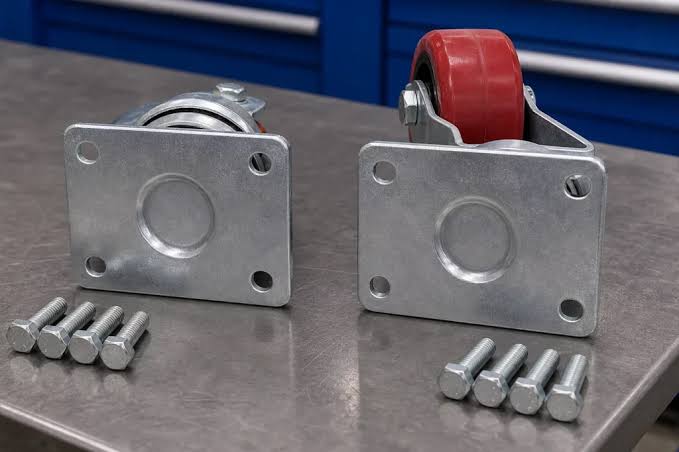
Castor Wheel Mounting Types Explained: Top Plate, Threaded Stem, Grip Ring, and Bolt Hole
You have calculated the exact load capacity, chosen the ideal polyurethane or nylon wheel tread, and decided between swivel and rigid configurations—yet when your replacement castors arrive at the workshop or hospital ward, they refuse to fit your trolley frame. Ordering the wrong mounting attachment is one of the most common and frustrating purchasing errors maintenance teams and procurement officers make.
Because industrial trolleys, medical beds, supermarket cages, office chairs, and stainless-steel kitchen tables use completely different frame designs, castor wheels are manufactured with several distinct fitting mechanisms. Understanding the four primary mounting types—and knowing which three measurements to take before ordering—ensures a bolt-on, hassle-free fit every time.
1. Top Plate Mount (4-Bolt Rectangular or Square Plate)
The top plate castor is the undisputed workhorse of Kenyan warehouses, factories, and commercial kitchens. It consists of a flat, heavy-gauge steel or stainless-steel plate welded or riveted to the top of the castor fork, featuring four elongated bolt holes at the corners.
- How It Attaches: Bolts directly onto the flat underside of a steel platform trolley, wooden dolly, machinery base, or welded mounting pad using four high-tensile bolts, washers, and nyloc nuts (or welded directly onto heavy steel frames).
- Strengths: Distributes heavy vertical and side-impact loads across a wide surface area—making top plates mandatory for heavy-duty industrial loads (from 150 kg up to 3,000+ kg per wheel). Elongated oval bolt holes also allow slight alignment tolerance when retrofitting older trolleys.
- Best For: Warehouse platform trolleys, supermarket roll cages, heavy toolboxes, generator frames, and industrial workbenches.
2. Threaded Stem Mount (Metric Bolt Stem)
Instead of a flat four-hole plate, a threaded stem castor features a single vertical threaded stud extending directly from the top of the swivel raceway (commonly in standard metric sizes such as M8, M10, M12, M16, or M20).
- How It Attaches: Screws directly into a pre-tapped threaded leg insert, or passes up through a single hole in a thin metal sheet/tube and secures from above with a hex nut and spring washer.
- Strengths: Compact footprint that fits neatly onto narrow tubular legs where a wide top plate would overhang and catch on obstacles.
- Watch Out For: Because all bending leverage concentrates on a single vertical bolt, threaded stems are best suited for light-to-medium loads (typically 40 kg to 200 kg per wheel) and smooth indoor floors rather than heavy side impacts over rough cabro.
- Best For: Commercial kitchen prep tables, light utility carts, display racks, medical equipment stands, and electronics cabinets.
3. Bolt-Hole (Hollow Kingpin) Mount
Frequently confused with threaded stems, a bolt-hole castor has no attached bolt at all—instead, it features a smooth hollow central hole (typically 10mm, 12mm, or 16mm diameter) passing straight through the swivel head.
- How It Attaches: You supply your own hex bolt or Allen screw, passing it upward through the castor’s hollow center into a threaded leg socket—or downward from inside a tubular leg or shelf corner into a nut beneath the swivel raceway.
- Strengths: Extremely versatile for OEM furniture and racking manufacturers, allows easy replacement without cutting welded studs, and lets technicians pair the castor with whatever bolt length their frame thickness requires.
- Best For: Stainless-steel catering tables, modular wire shelving, retail display gondolas, and light institutional carts.
4. Grip-Ring (Circlip) & Expanding Rubber Adapter Stems
Tubular steel equipment—such as hospital beds, IV drip stands, office chairs, and laundry carts—usually has hollow round or square legs with no internal threads. Two specialized stem designs lock securely inside open tubing:
A. Grip-Ring (Circlip) Stem
Features a smooth steel stem with a spring-steel compression ring (circlip) near the top. Pushing the stem firmly into a matching socket or plastic leg insert snaps the ring into an internal groove—holding the castor securely during lifting while allowing technicians to pry it out quickly for replacement.
- Best For: Office chairs (standard 11mm × 22mm grip-ring stem), IV stands, lightweight hospital carts, and restaurant service trolleys.
B. Expanding Rubber (or Nylon) Adapter Stem
Designed specifically for hollow round or square metal tubing (such as 22mm, 25mm, 28mm, or 32mm round tubes and 25×25mm or 30×30mm square legs). Turning a hex nut at the base of the stem compresses a thick rubber or nylon sleeve outward against the inside walls of the tube, creating a rock-solid friction grip without welding or drilling.
- Best For: Hospital beds, tubular stainless-steel kitchen tables, bakery racks, and tubular steel trolleys.
Quick Comparison: Choosing the Right Castor Mounting System
| Mounting Type | Load Suitability | Frame Requirement | Best Applications |
| 4-Bolt Top Plate | Medium to Extreme Heavy Duty | Flat bottom deck or welded steel pad | Warehouse trolleys, roll cages, heavy machinery |
| Threaded Stem (M10–M20) | Light to Medium Duty | Pre-tapped leg socket or thin flange | Display stands, light utility carts, small appliances |
| Hollow Bolt Hole | Light to Medium Duty | Single mounting hole or hollow leg | Modular shelving, catering tables, retail racks |
| Grip-Ring (Circlip) Stem | Light Duty | Precision stem socket / plastic insert | Office chairs, IV drip stands, light medical carts |
| Expanding Adapter Stem | Light to Medium-Heavy Duty | Open round or square metal tube legs | Hospital beds, tubular stainless tables, bakery racks |
4 Essential Measurements to Take Before Ordering Replacement Castors
Before calling a supplier or placing a bulk order, grab a tape measure or vernier caliper and record these four figures from your existing castor:
- Overall Installed Height: Measure from the floor to the top of the mounting plate (or the base of the stem collar). Matching exact height prevents trolley wobble when replacing a single worn wheel.
- Top Plate Size & Bolt-Hole Spacing: Measure the outer dimensions of the plate (e.g., 100×85mm or 135×110mm) and the center-to-center distance between bolt holes (e.g., 80×60mm or 105×80mm).
- Stem Diameter & Length (or Tube Inner Diameter): For threaded stems, verify both thread diameter (e.g., M12) and stem length (e.g., 25mm). For expanding stems, measure the exact inside diameter of the round or square metal leg.
- Wheel Diameter & Tread Width: Measure across the wheel face (e.g., 125mm × 32mm) to ensure adequate clearance inside the trolley frame and proper load rating.
Need Help Matching Replacement Castors to Your Existing Equipment?
Send us a quick photo and the four measurements above—we stock top-plate, threaded-stem, bolt-hole, grip-ring, and expanding-tube castors in polyurethane, nylon, TPR, and stainless steel across Kenya. Contact our team today for fast matching and bulk quotes.
You may also like



Leave a Reply